
Signing for Decorated Haircare Bottles: Questions Most Brands Forget
The expensive parts of a decorated haircare packaging contract are not the price. They are the clauses nobody thought to ask about: who owns the print tooling, who holds the artwork file, what counts as a defect, and what happens when a bulk run does not match the approved decoration. Each of those questions costs nothing before signature and a great deal afterwards.
Key takeaways
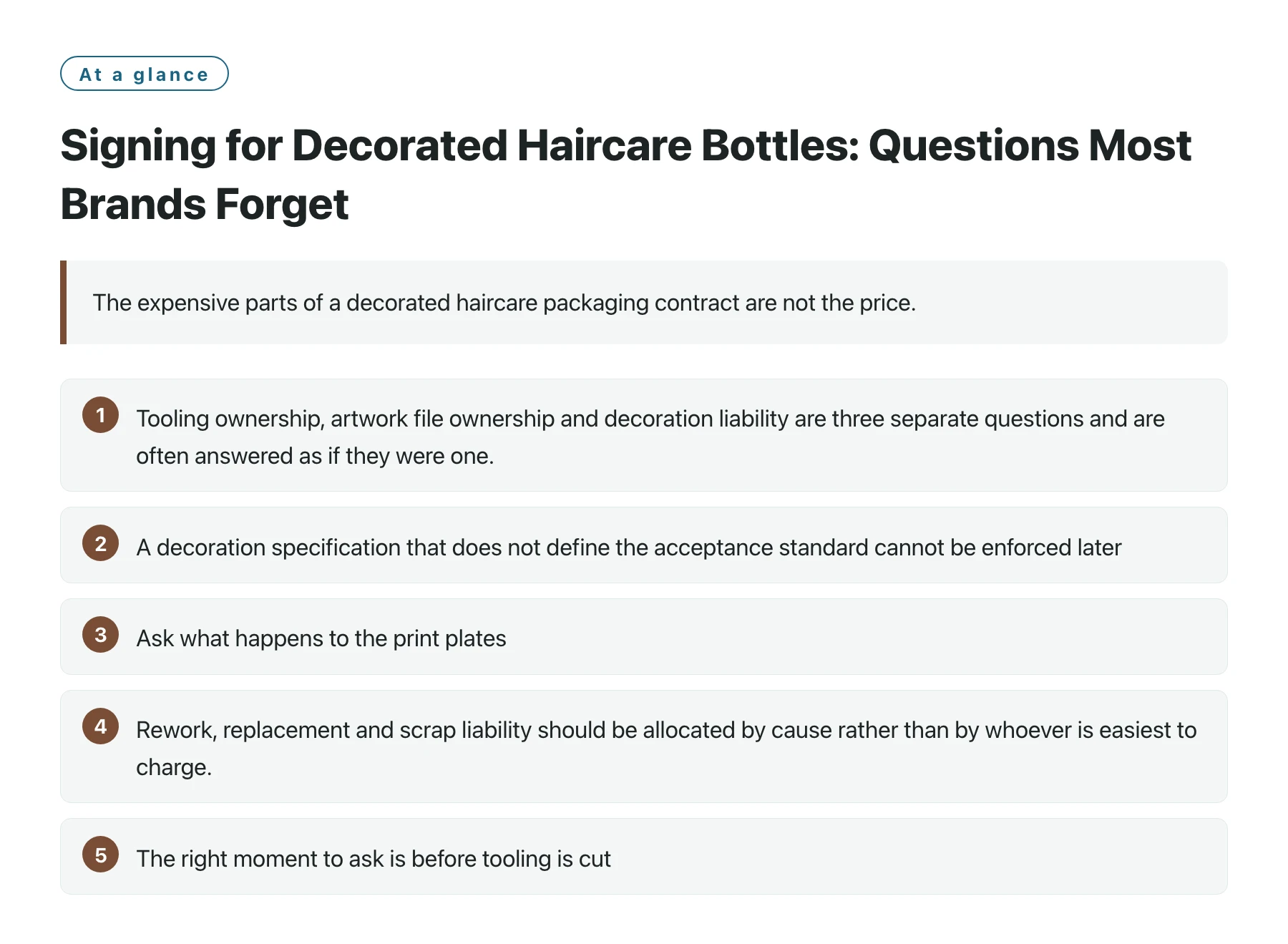
- Tooling ownership, artwork file ownership and decoration liability are three separate questions and are often answered as if they were one.
- A decoration specification that does not define the acceptance standard cannot be enforced later, because there is nothing to measure against.
- Ask what happens to the print plates, screens or cylinders at the end of an order, including whether another brand could use them.
- Rework, replacement and scrap liability should be allocated by cause rather than by whoever is easiest to charge.
- The right moment to ask is before tooling is cut, because the tooling decision locks in both the technique and the cost structure.
Formula questions tend to get asked because they feel technical. Decoration questions tend to be skipped because they feel administrative, and administration is exactly where the money goes when something goes wrong. A contract that describes the bottle and the print but not the standard, the tooling or the remedies is an incomplete agreement, however long it is.
The purpose of a pre-signature conversation is not to negotiate aggressively. It is to make sure that the two parties have the same picture of what will happen if a bulk run arrives looking different from the approved sample.
These are the questions that produce that picture.
Why decoration questions differ from formula questions
A formula is intangible and is owned in a way that contracts can describe: a document, a specification, a set of use rights. Decoration involves physical tooling and a visual standard, and both are harder to describe precisely. A plate exists and can be moved; a colour standard exists only if someone agreed what it was.
Decoration is also the step where a brand most often loses control of its own artwork, because the file is prepared or adjusted by a supplier. That is one reason a brand going into decorated packaging should look for a partner that handles fragrance manufacturing under one roof rather than coordinating the printer, the bottle trader and the filler itself, since fewer interfaces means fewer places for a file or a standard to be lost.
The questions, grouped by what they test
Group the questions by function rather than by topic, and the contract conversation becomes short. There are only three functions to settle: who owns what, what standard applies, and who answers for a failure.
Ownership: tooling, files and plates
Ask who owns the print tooling and whether that ownership transfers to the brand at the end of the order. Ask who holds the artwork file and in which format. Ask what happens to the plates, screens, cylinders or sleeves at the end of the project, and whether they are retained, destroyed or reusable for another client. Protection for designs and confidential know-how does not happen automatically; WIPO administers the international treaties through which industrial designs and trade secrets are protected [1], and a contract that never mentions ownership leaves the question where it started.
Standard: what counts as correct
Ask which standard the decoration will be measured against, and get the answer in a form someone on a line can apply. The approved artwork proof, a sealed master sample, or a written tolerance are all usable. A verbal recollection of what the sample looked like is not, and a bulk run judged against it will always be arguable.
Independent testing companies list packaging and print performance among their cosmetics and personal care testing services [2], so where a standard is difficult to define visually, an agreed test method is a practical alternative.
Liability: who pays for a failed run
Ask who bears the cost of rework when decoration fails, and how cause is established. Most decoration disputes are resolved by identifying whether the cause was the substrate, the artwork, the process or the handling, and that identification is much easier if the process record was agreed in advance and retained after the run.
Ask as well what happens to bottles that were decorated before a defect was detected. In haircare, where the bottle is often the most expensive single component, the question of whether decorated rejects are charged at bottle cost or at decorated cost can change the size of a claim substantially.
A contract that names a decoration technique but not the standard for accepting it has delegated the definition of quality to whoever inspects first. Decide the standard yourself, before the tooling is cut.
A weak answer and a usable answer, side by side
| Question | Weak answer | What a usable answer contains |
|---|---|---|
| Who owns the print tooling? | We look after it for you. | A named owner, a transfer or retention term, and a stated cost to move it |
| What standard is the decoration judged against? | It will look like the sample. | A signed proof, a sealed master sample, or written visual criteria |
| What happens if the run is off-standard? | We will sort it out. | Rework and replacement terms, allocated by cause, with a time limit |
| Who owns the artwork file? | We keep a copy for re-orders. | The owning party, the format, and the conditions for release |
| What if we change decorator later? | That will not happen. | Which assets transfer, in what condition, and at what cost |
| How is handling damage after decoration handled? | Our team is careful. | Packaging specification, inspection point and responsibility split |
Read the middle column again after the meeting. It often looks reassuring in the room and empty on paper, which is exactly the failure this table is designed to expose.
Keeping the answers where they can be used
Write the answers into the agreement as short, specific sentences rather than as general commitments. A standard should be identifiable, a tooling owner should be named, and a liability rule should say what it applies to. Where the parties agree on a master sample, record the sample's identity in the contract so that the object and the obligation stay connected.
Then keep the process record. A signed standard is only useful if the run that produced the bulk can be reconstructed, and that means keeping the parameters, the inspection notes and the retained sample together with the order. A partner used to supporting OEM and ODM programmes, such as Xuelei, will already keep those records and can explain how they are retained and released.
Finally, check the whole scope once more against Xuelei Perfumes. A manufacturer that sets out its services publicly is easier to contract with, because the conversation starts from a written scope rather than from a sales presentation.
Sources
- WIPO — World Intellectual Property Organization —— The UN agency for intellectual property; resources on industrial design and patent protection relevant to product and packaging design.
- SGS: Cosmetics, Personal Care & Household Testing —— Testing, inspection and certification services for cosmetics and personal care, including microbiological, stability and safety testing aligned with cosmetics GMP.
Frequently asked questions
Who should own the print tooling for a decorated bottle?
Either party can, as long as the contract says so and states what happens at the end of the relationship. Many brands prefer to own tooling they have paid for, so that changing decorator does not mean paying for the same plates twice.
Does email approval of artwork count as a signed proof?
It can, if the email identifies the exact file version and the proofing conditions and is filed with the order. What causes problems is a chain of revisions with no clear statement of which version was approved.
How should decoration defects be defined in a contract?
By reference to an agreed standard: a sealed master sample, written visual criteria, or a test method. Defects defined only by adjectives such as acceptable or minor cannot be applied consistently and will be argued about.
What happens to decorated rejects if the glass or bottle was supplied by us?
That has to be agreed in advance, because the bottle is often the most valuable component. The contract should state whether rejects are charged at bottle cost, at decorated cost, or at a defined allowance.
Do we need to ask these questions before tooling is cut?
Yes. The technique, the tooling cost and much of the cost structure are fixed once tooling is made, and changing any of them afterwards usually means new tooling rather than a renegotiation.
The Atelier — Lyon, since 2009
Each piece drawn, cut, and finished by hand.
Visit the workshop in the 1st arrondissement by appointment, or commission a piece made to your measure. Six-week lead time, lifetime guarantee on every numbered edition.
Begin a Bespoke Commission →