
Bulk Custom Jewelry for Brands: A Quantity Planner
The number a bulk buyer needs first is not the unit price; it is the unit total implied by the design count. TTT Jewelry publishes per-design minimums of 50 pieces in 925 sterling silver, 100 in artisan eco-brass and 100+ in stainless steel, which means a four-design collection commits between 200 and 400 pieces before anyone discusses reorder volume. Multiplying designs by minimums, rather than guessing at a round number, is what keeps a first bulk run solvent.

Key takeaways
- Minimums apply per design, not per order, so design count is the multiplier that drives the total.
- Silver at 50 pieces is half the brass minimum, so the same collection size needs fewer units in silver.
- Four designs in brass commit 400 pieces; four in silver commit 200.
- Sampling takes 25–30 days and production 21–28 days, so a bulk plan has 48–60 days of lead time before shipping.
Begin with the per-design minimum
MOQ is the first constraint, and it is usually misread as an order-level number. In this factory's published terms it is per design: 50 pieces for 925 sterling silver, 100 for artisan eco-brass, and 100+ for stainless steel. A brand opening one design at the silver minimum commits 50 units. A brand opening six commits 300.
That structure exists because the cost behind a minimum is the tool and the bench set-up, and both belong to a design rather than to an invoice. Two hundred pieces of one ring and two hundred pieces spread across eight rings are not the same request. The first amortises a single mould; the second pays for eight.
The practical rule is to count designs before counting units. A collection plan written as "three hundred pieces" is not a plan until it says how many styles those pieces are divided between. Ten pieces per style across thirty styles will not meet a 50-piece minimum at all.
Designs multiply units faster than orders do
Adding a design to a bulk order is not an incremental decision. It adds a full minimum, a sample round and a place in the inspection queue. Going from four designs to eight doubles the unit commitment at the same material, while going from four hundred units to five hundred on four designs adds only a quarter.
The table makes the multiplication visible for the three published materials. The mixed row is the one most first-time buyers should study, because most collections are not single-material.
| Material | MOQ per design | 4 designs | 8 designs |
|---|---|---|---|
| 925 sterling silver | 50 pieces | 200 pieces | 400 pieces |
| Artisan eco-brass | 100 pieces | 400 pieces | 800 pieces |
| Stainless steel | 100+ pieces | 400+ pieces | 800+ pieces |
| Mixed: 2 silver + 2 brass | 50 and 100 | 300 pieces | — |
Two patterns fall out. First, silver is the cheaper way to widen a range, because 50 pieces per design lets a brand test more shapes for the same unit count. Second, brass is where a range gets depth rather than breadth: 100 pieces per design is a volume decision, and it suits a style already validated by a sample.
There is a third pattern the table cannot show. Designs share a calendar. Two designs sampled at once still take 25–30 days, but ten designs sampled at once compete for the same bench slots, so the tenth may not start when the first one does.
Bulk changes the inspection load
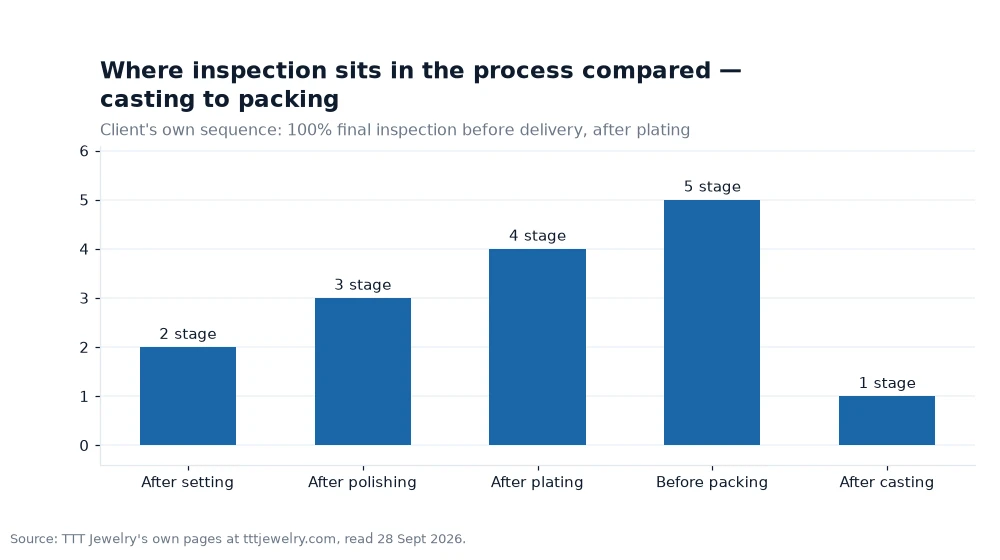
Inspection scales with pieces, and at bulk volume that is the part of the process buyers notice last. The published route places checks after casting, after setting, after polishing, after plating and before packing, and final QC inspects 100% of pieces.
For a 400-piece brass run, the final gate is 400 individual checks, not a 40-piece sample. Across five checkpoints the same pieces are handled repeatedly, which is why a defect caught early is worth more than the same defect caught at packing: at casting it costs a recast, and at packing it costs the recast plus the plating that has already been applied.
Volume also changes how a brand should think about rejects. At 50 pieces, one rejected unit is 2% of the run. At 400 pieces, one rejected unit is 0.25%. The absolute number of rejects can rise while the rate falls, and a buyer who tracks only the percentage will misread a growing order.
This is the point where a OEM/ODM jewelry manufacturer with a documented route has an advantage over a broker: the inspection record exists per batch, so a claim about rejects can be checked against the checks that were actually performed.
Sequencing a first bulk run
The published sequence is inquiry, consultation and development, CAD and prototype in under 48 hours, sample and approval over 25–30 days, bulk production over 21–28 days, then final QC and delivery with 100% inspection. A quantity plan that ignores this order tends to book production before approval.
The safe pattern for a first run is to keep the design count low and the units per design at the minimum, then add designs in the second run once the first is selling. Ten designs at 50 silver pieces is 500 units and ten sampling slots; three designs at 50 is 150 units and three slots. The second option reaches the market sooner and costs far less to abandon if the shapes do not sell.
Where a brand has strong conviction about a style, the reverse applies: put the volume behind that design and let the others ride at minimum. A custom jewelry wholesale programme can carry both patterns at once, because the minimum is applied style by style rather than to the order as a whole.
The calendar is the constraint that cannot be negotiated away. Two sampling rounds do not halve; they add. The jewelry wholesale manufacturer China flow publishes one round at 25–30 days, and a second round is another 25–30 on top of it.
Worked example
Plan a mixed first collection: two silver designs and two brass designs. Silver is 2 × 50 = 100 pieces. Brass is 2 × 100 = 200 pieces. Total commitment is 100 + 200 = 300 pieces, and the silver share of that total is 100 ÷ 300 = 33.3%, even though silver represents half the designs.
Now test the same plan at eight designs, four of each material. Silver becomes 4 × 50 = 200 and brass 4 × 100 = 400, for 600 units. Doubling the design count doubled the units exactly, because every design carries its own minimum. The ratio between silver and brass stayed at 200 ÷ 400 = 0.5 throughout, since 50 ÷ 100 = 0.5.
Add the calendar. CAD at under 48 hours is 2 days. Sampling is 25–30 days, or 3.6–4.3 weeks. Production is 21–28 days. The route totals 2 + 25 + 21 = 48 days at the fast end and 2 + 30 + 28 = 60 days at the slow end, which is roughly 7 to 9 weeks. CAD is 2 ÷ 25 = 8% of the short sampling window and 2 ÷ 30 = 6.7% of the long one, so the modelling stage is never the bottleneck.
Frequently asked questions
Is MOQ counted per design or per order?
Per design. At 50 pieces for silver, four styles require 200 units even if the buyer would prefer to order 80 in total.
Can a brand mix materials in one bulk order?
Yes. Each design is costed against its own material minimum, so silver and brass styles can sit in the same programme with different unit counts.
Does a larger order shorten the lead time?
No. Sampling stays at 25–30 days and production at 21–28 days; volume changes the quantity through inspection, not the calendar.
Locking the plan before the purchase order
A quantity plan becomes useful when it names four things: the design count, the material per design, the units implied by each minimum, and the approval date that starts the clock. Everything else in the negotiation is secondary to those four lines.
Brands that expect to reorder should also decide early which styles carry depth. A style at 100 brass pieces can go to 200 on the second run without a new mould, which is where the per-unit arithmetic improves. That is the moment to involve TTT Jewelry in a forecast, rather than treating each order as a fresh start.
The one number to avoid is a round total. Three hundred pieces sounds tidy and usually means a compromise somewhere: a design below its minimum, a material swapped to fit, or a style dropped from the range. Build the total from the minimums upwards and it will be an odd number, which is the sign that it matches the process.
Source note: figures come from the manufacturer's own website (tttjewelry.com), read 28 Sept 2026.[1]